
On this page
This guide introduces the main ways to interact with the Money On Chain protocol.
By the end, you will understand how the protocol works, the role of each token, and the actions available to users.
Before You Start
To use Money On Chain, you will need:
- A compatible wallet.
- Some rBTC to pay network fees.
- Access to the Money On Chain dApp.
If you have not completed these steps yet, start with the Getting Started guide.
The Money On Chain Tokens
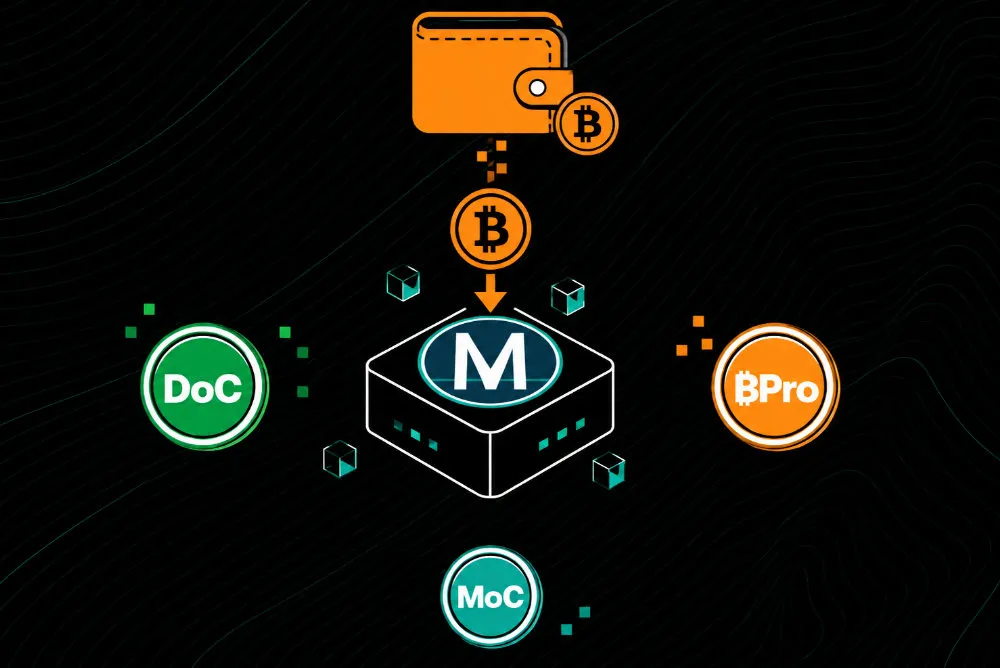
The protocol revolves around three main tokens:
DOC - Dollar On Chain
DOC is a Bitcoin-backed stablecoin designed to maintain a value of 1 DOC = 1 USD.
Unlike traditional stablecoins, DOC does not rely on bank reserves or centralized custodians. Its peg is maintained through the Money On Chain protocol and its smart contracts.
Users typically use DOC when they want to reduce Bitcoin price volatility while remaining within the Bitcoin ecosystem.
DOC can be obtained by minting it through the protocol using rBTC or by acquiring it through supported secondary markets. It can also be redeemed directly through the protocol.
BPRO
BPRO is designed for users seeking additional Bitcoin exposure through the protocol.
BPRO can be obtained by minting it through the protocol using rBTC or by acquiring it through supported secondary markets. It can also be redeemed directly through the protocol.
In addition to its role within the protocol, holding BPRO allows users to receive MOC tokens through the Liquidity Mining program.
MOC
MOC is the governance token of the Money On Chain protocol.
Unlike DOC and BPRO, MOC cannot be minted or redeemed through the protocol.
MOC can be earned through Liquidity Mining or acquired through supported secondary markets.
MOC holders can stake their tokens, earn rewards, and participate in governance.
Minting and Redeeming Tokens
One of the main features of Money On Chain is the ability to interact directly with the protocol’s smart contracts.
Users can mint DOC and BPRO using rBTC and later redeem those tokens according to the protocol rules.
Unlike buying or selling tokens on an exchange, minting and redeeming interact directly with the protocol itself.
Earning MOC Rewards
BPRO holders receive MOC tokens through the Liquidity Mining program.
The program distributes MOC daily among BPRO holders, with each user receiving a share proportional to their BPRO holdings.
Rewards accumulate over time and can be claimed through the dApp.
Staking MOC
MOC holders can stake their tokens to earn staking rewards and participate in protocol governance.
Users can also stake MOC to operate an OMOC oracle node, helping secure the protocol’s price feeds and earning rewards for their participation.
Both mechanisms provide incentives for actively contributing to the Money On Chain ecosystem.
Participating in Governance
Money On Chain is governed through a community voting process.
MOC holders and stakers can participate in governance decisions by voting on protocol proposals.
Governance proposals are discussed publicly before entering the voting process and, if approved, are implemented through the protocol governance system.
Next Steps
Continue with the guides that match your goals:
- Mint and Redeem Tokens
- Claim MOC Rewards
- Stake MOC
- Participate in Governance
- Run an OMOC Oracle Node