
On this page
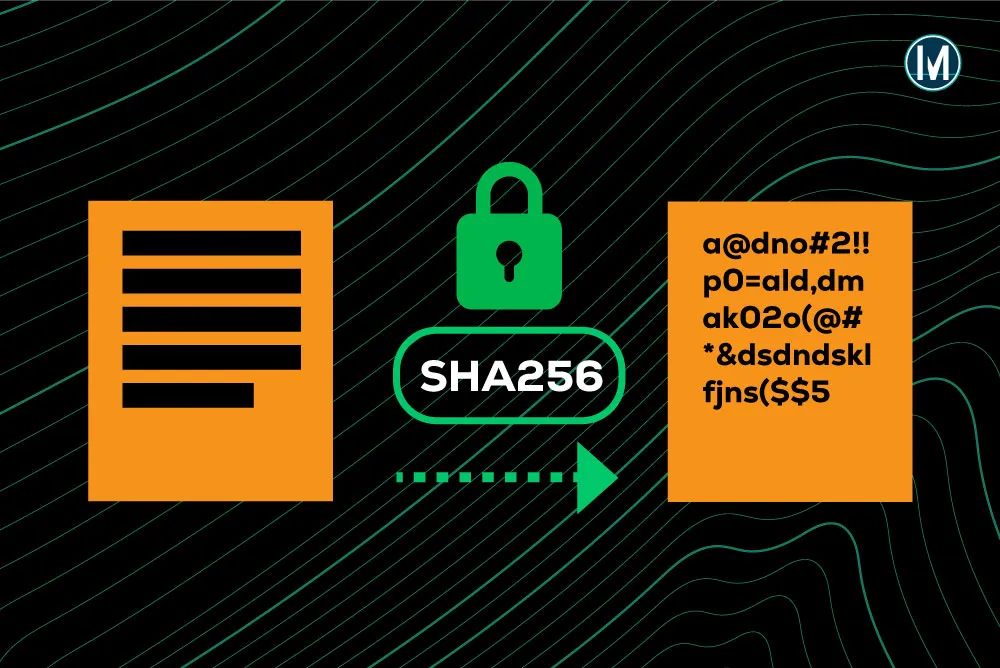
The SHA-256 algorithm (Secure Hash Algorithm 256) is a cryptographic function that transforms any kind of information into a unique 256-bit code. This is represented as a 64-character string in hexadecimal format. It’s one of the most secure and widely used functions today, especially in blockchain, cybersecurity, and data validation.
How does SHA-256 work?
SHA-256 takes a message of any length and processes it by splitting it into 512-bit blocks. It then applies a series of mathematical, logical, and bitwise operations (rotations, shifts, modular additions, and more) to transform these blocks into a final 256-bit output.
This transformation is deterministic: the same data will always generate the same hash, but a small change in the input will produce a completely different result. This property is called the avalanche effect.
Key characteristics of the SHA-256 algorithm
- Deterministic: it always produces the same hash for the same data.
- Irreversible: it is mathematically impossible to recover the original input from the hash.
- Improbable collisions: two different inputs should not generate the same hash.
- Fast: it can be executed quickly, even on large volumes of data.
Practical applications of SHA-256
1. Blockchain and cryptocurrencies
SHA-256 is at the core of Bitcoin’s mining algorithm. Every block in the blockchain contains a hash that represents its contents. If any part of the block is modified, the hash changes, making the tampering obvious.
2. Digital signatures and certificates
When creating a digital signature, a hash of the original document is generated. This hash is then signed with a private key. The recipient can verify the signature by generating the hash of the document and comparing it to the original.
3. Integrity verification
When downloading software or important files, many websites provide the SHA-256 hash so you can verify that the content wasn’t altered during the download.
4. Secure password storage
Although SHA-256 is not specifically designed for password hashing (where bcrypt or Argon2 are preferred), in legacy systems it may be found as a simple hashing method.
SHA-256 vs. other algorithms
SHA-256 is part of the SHA-2 family, which also includes SHA-224, SHA-384, and SHA-512. Unlike SHA-1, which was compromised by collision attacks, SHA-256 is still considered secure and reliable.
A simple example to understand it
Imagine you write "Hola mundo" and apply SHA-256:
- Hash:
64ec88ca00b268e5ba1a35678a1b5316d212f4f366b2477245fbcf8e5b2c5be3
Now you change one letter: "Hola Mundo" (with a capital M)
- Hash:
fcea920f7412b5da7be0cf42b8c93759d112e33d
As you can see, the hash changes completely, even though the text is almost identical. This ensures that any modification, no matter how small, can be detected.
Understanding SHA-256 is valuable not only for developers and cybersecurity experts. It’s also key for anyone interested in data protection, blockchain technology, or simply learning how the pillars of the modern Internet work. Start by generating your own hashes, verifying file integrity, or exploring its use in smart contracts. The possibilities are as robust as the algorithm itself.