
On this page
Have you ever sent Bitcoin and seen the transaction remain “pending” longer than expected? In many cases, the reason lies in the mempool, a key part of blockchain infrastructure that determines what happens between the moment you sign a transaction and the moment it is finally confirmed in a block.
Understanding what a mempool is can help you interpret network fees, identify congestion, and reduce the risk of a transaction getting stuck because the fee was set too low.
What is a mempool?
The term mempool is short for memory pool. It refers to the set of transactions that a node has received and accepted but that have not yet been included in a block.
You can think of it as a waiting room: transactions arrive, are checked, and remain pending until a block producer chooses to include them.
However, there is an important detail: there is no single global mempool. Each node maintains its own version based on the transactions it has received and the policies it applies. As a result, different nodes may have slightly different sets of pending transactions.
How does the mempool work step by step?
When you send cryptocurrency from a wallet, the process does not end when you click “send.”
First, your wallet creates and cryptographically signs the transaction. It then broadcasts the transaction to the network, where nodes check whether it complies with the relevant rules, such as signature validity and whether the funds being spent are available.
If a node accepts the transaction, it enters that node’s mempool and may be propagated to other participants.
The simplified process looks like this:
Wallet → nodes → mempool → block → confirmations
While a transaction remains in the mempool, it is still unconfirmed. It only becomes part of the blockchain once it is included in a block.
That is why seeing a transfer marked as “pending” does not necessarily mean something has gone wrong. It may simply be waiting for block space.
Why do fees affect the mempool?
Block space is limited. When more transactions are waiting than can be processed immediately, users compete for inclusion in upcoming blocks.
In Bitcoin, priority is strongly influenced by the fee rate, usually measured in sat/vB, or satoshis paid per virtual byte of transaction data. In general, a transaction offering a competitive fee rate has a better chance of being confirmed sooner than one paying less.
This is one of the main reasons network fees fluctuate.
When activity is low, relatively inexpensive transactions may confirm quickly. When the mempool fills up, users who want faster confirmation tend to offer higher fees.
In other words, the mempool does not behave like a simple first-in, first-out queue.
What does a congested mempool mean?
A congested mempool means that many pending transactions are competing for the limited space available in upcoming blocks.
For users, this usually has two consequences:
- Longer waiting times for transactions with low fees.
- Higher fees for users who need fast confirmation.
The network is not necessarily broken. Blocks may still be produced normally while demand temporarily exceeds the available block space.
On Bitcoin, tools such as mempool.space make it possible to monitor pending transactions, projected blocks, and estimated fee rates, helping users assess congestion before sending funds.
Why can a transaction get stuck?
One of the most common reasons is setting a fee that is too low compared with other transactions competing at the same time.
Imagine that you send BTC with a fee rate of 2 sat/vB. Shortly afterward, network activity rises and many new transactions begin paying significantly higher rates. Miners have an economic incentive to include the more profitable transactions first, so yours may remain pending.
This does not automatically mean your funds are lost.
As long as the transaction remains unconfirmed, what happens next will depend on network conditions, node policies, and the features supported by your wallet.
How can you speed up a pending transaction?
Bitcoin supports mechanisms such as RBF, or Replace-by-Fee, which allows certain unconfirmed transactions to be replaced with a new version offering a higher fee.
Another method is CPFP, or Child Pays for Parent. In this case, a new transaction spends an output from the pending transaction and includes a high enough fee to make confirming both transactions economically attractive.
Not every wallet supports the same options, so it is worth checking your wallet’s features before trying to speed up or replace a transaction.
On account-based networks such as Ethereum, the mechanism works differently. A pending transaction may be replaced by another transaction using the same nonce the sequential number associated with transactions from an account and a sufficiently higher fee.
How to check the Bitcoin mempool
One of the best-known tools is mempool.space. Its dashboard allows users to inspect pending transactions, projected blocks, and current fee conditions. Its API also provides mempool statistics and recommended fee estimates.
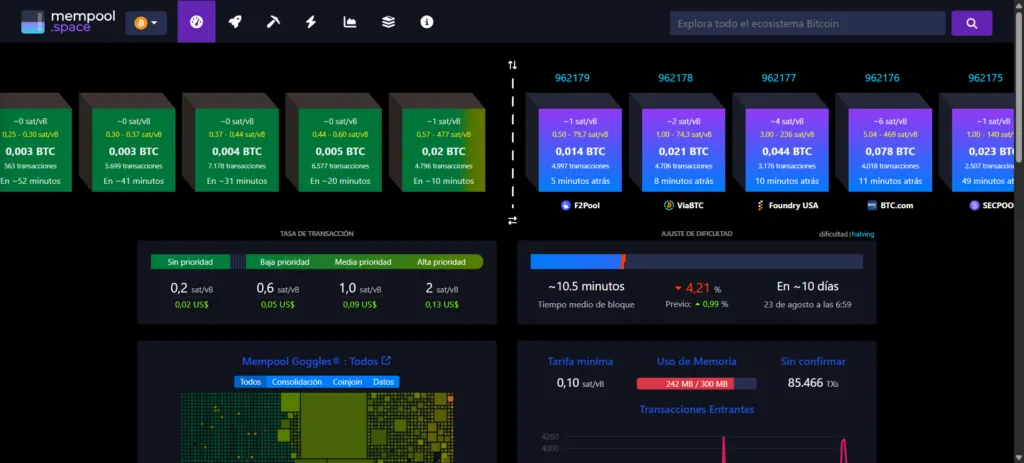
Before sending a transaction that is not urgent, checking the state of the mempool can help you decide whether to pay for priority or wait until network demand decreases.
The key idea is simple: once a transaction is broadcast, it still has to compete for scarce network resources. The mempool makes that competition visible. Once you understand how to read it, fees and confirmation times stop looking arbitrary and start making technical sense.