
On this page
All freedom comes with responsibility. Bitcoin lets you avoid intermediaries that hold your funds and institutions that can “reset” your access. That freedom has a central, and often underestimated, point: the seed phrase.
Understanding what a seed phrase is and why it’s critical is not just a technical detail. It’s understanding what it really means to own bitcoin.
What is a seed phrase?
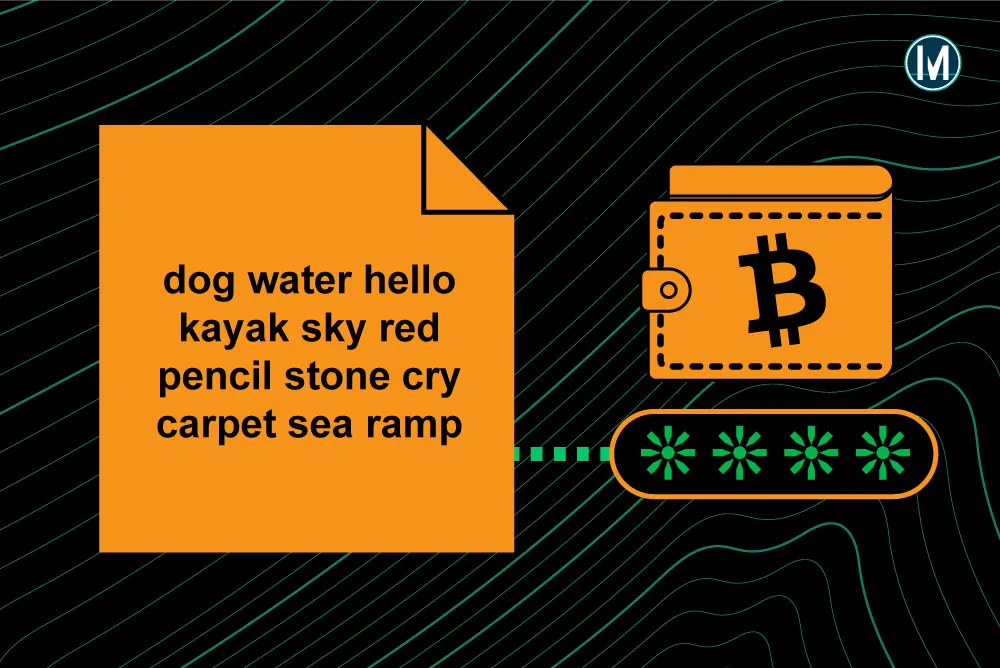
A seed phrase is a list of words, usually 12 or 24, that serves as a complete backup of your Bitcoin wallet. From that phrase, all your private keys and public keys are generated, as well as the addresses you use to receive bitcoin.
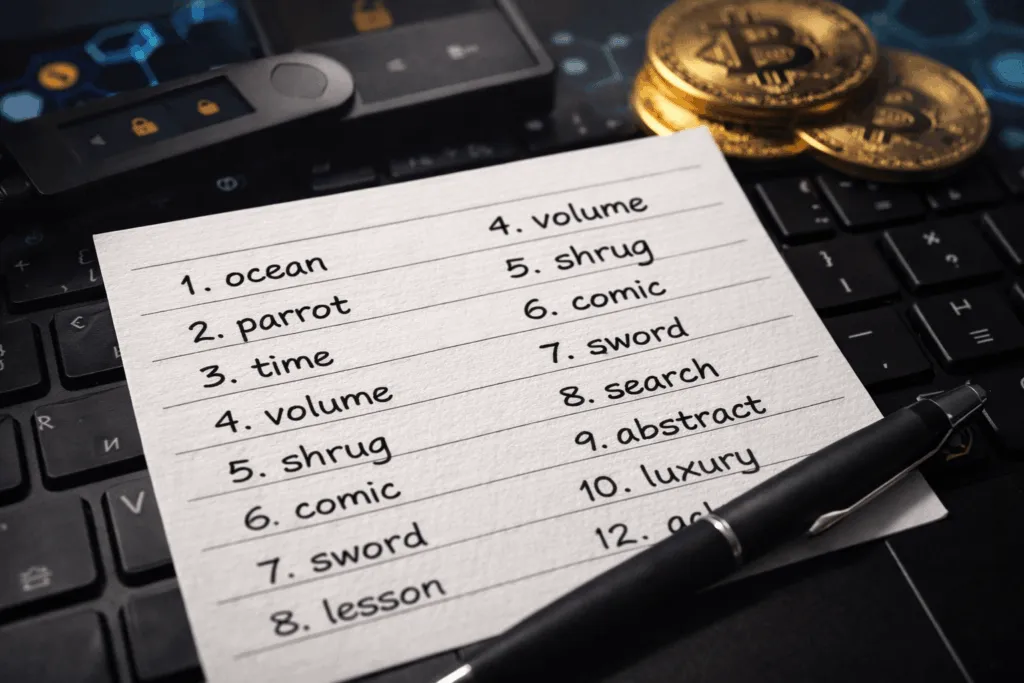
Put simply: the seed phrase is the root of your wallet.
- It’s not a password.
- It’s not a username.
- It doesn’t depend on any specific app.
It’s the piece of information that lets you reconstruct your entire wallet in any compatible wallet, at any time and in any place.
The relationship between seed phrase, keys, and addresses
To understand its importance, it helps to see the flow:
- Seed phrase: This is the starting point. A human-readable representation (in words) of a very large secret number.
- Private keys: From the seed, multiple private keys are generated. Each one lets you sign transactions and spend bitcoin.
- Public keys and addresses: From the private keys, public keys are derived and, from those, the addresses you share to receive payments.
That entire cryptographic tree grows out of the seed phrase. That’s why people often say “whoever has the seed, has the bitcoin.”
You may be interested in: What is a Bitcoin address and how does it work?
The standard behind it: why words and not numbers
Seed phrases follow a widely adopted Bitcoin standard (BIP39) that defines:
- A fixed word list
- A precise order
- Rules to detect errors
The goal? To allow a person to write down, read, and restore their wallet without relying on a digital file or any specific provider.
The words themselves are not what make it secure; they’re just a more practical way to represent cryptographic information. The security still lies in the secrecy.
Wallet, app, and seed: not the same thing
Another key point: the wallet is not the app.
- The app (mobile, desktop, or hardware) is just an interface.
- The real wallet is the seed phrase.
You can delete the app, change devices, or use different software: with the seed, you recover everything.
This is essential to understanding self-custody: you’re not tied to any company, server, or brand.
Common (and dangerous) mistakes
Most losses in Bitcoin are not caused by protocol failures, but by human error. Some of the most frequent:
- Taking a photo of the seed
- Storing it in the cloud, email, or phone notes
- Sending it over WhatsApp “just in case”
- Sharing it with someone “you trust”
- Confusing the seed with a password that can be recovered
Any digital form exposed to the internet breaks the security model. If someone gets access to the seed, they don’t need permissions, verifications, or help from third parties.
Basic custody best practices
Without getting into advanced setups, here are some simple rules:
- Write the seed down offline, preferably on paper or metal.
- Don’t make digital copies.
- Store copies in different physical locations.
- Avoid having a single person hold all the information if the amount is significant.
- Test restoring the wallet in a controlled environment (before trusting it with large amounts).
Perfect custody doesn’t exist. There are always trade-offs between security, convenience, and risk. The important thing is being aware of them.
Self-custody: freedom with responsibility
Bitcoin makes something unprecedented possible: being your own bank.
But that means accepting a reality that’s uncomfortable for many:
- No one can freeze your funds.
- No one can censor a valid transaction.
- And no one can help you if you lose your seed phrase.
The seed phrase is not a technical footnote: it’s the core of the financial sovereignty that Bitcoin offers.
Understanding it and protecting it is the first step toward using Bitcoin responsibly. And also, toward stopping relying on other people’s promises and starting to trust in verifiable rules.
Because in Bitcoin, as in life, freedom does not come without responsibility.