
On this page
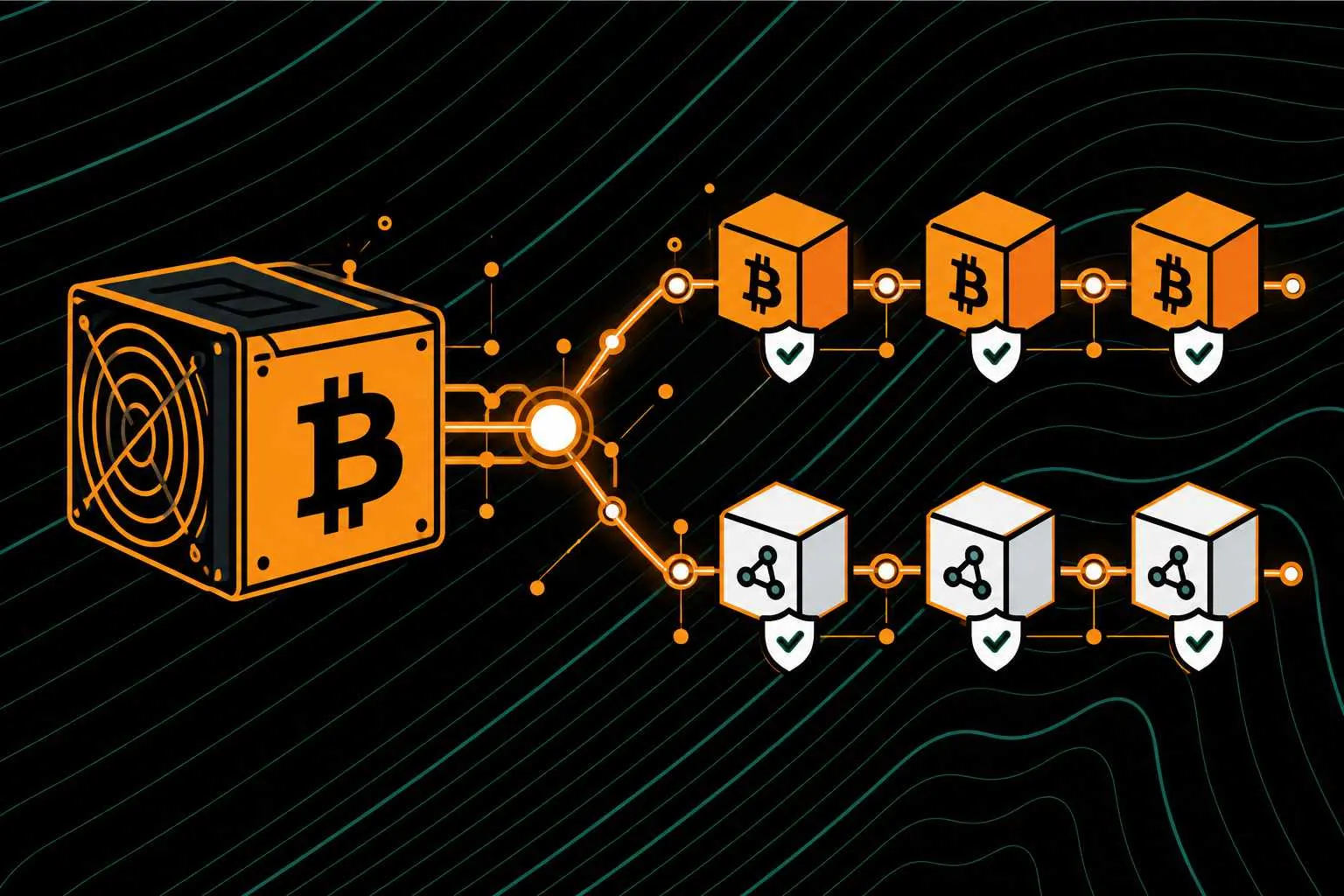
Merged mining is a technique that lets a miner use the same computational work to secure two blockchains at once, without spending extra energy or buying new hardware. It is how Bitcoin’s mining power secures Rootstock, the smart contract network where protocols like Money On Chain run: most of Bitcoin’s mining power also works for that network.
In this guide you will learn what merged mining is, how it works step by step, what miners earn from it, what its risks are, and why it matters if you use DeFi on Bitcoin.
What is merged mining?
Merged mining, also known as AuxPoW (Auxiliary Proof of Work), is a way to mine two blockchains that use the same proof-of-work algorithm with a single computational effort.
The idea is simple. Mining Bitcoin means trying millions of combinations until you find a hash that meets the network’s difficulty target. That work is expensive. Merged mining lets the same work also count toward a second network, called the auxiliary chain.
For the miner, the result is extra rewards from a second network for the same work. For the auxiliary chain, the result is protection from mining power it would struggle to attract on its own.
A short history
Merged mining is not new. The first network to merge-mine with Bitcoin was Namecoin, in 2011. Later, Dogecoin adopted merged mining with Litecoin. Rootstock applied the technique to a smart contract network connected to Bitcoin, and today it is one of the largest-scale examples.
How merged mining works, step by step
Rootstock’s implementation is well documented, so let’s use it as the example:
- The mining pool builds its Bitcoin block as usual: it selects transactions and prepares the coinbase transaction, which pays the block reward.
- It adds a reference to a Rootstock block. In the last output of the coinbase, the pool includes an
OP_RETURNfield with the tagRSKBLOCK:followed by information about the Rootstock block it wants to mine. It is a small piece of data that does not change how Bitcoin works. - Miners hash as usual. They search for a valid hash for the Bitcoin block. They do not run different software or use more energy.
- Each solution is checked against both difficulty targets. Rootstock produces blocks far more often than Bitcoin (one every 30 seconds on average, versus 10 minutes), so its difficulty is lower. Many solutions that are not enough to close a Bitcoin block are enough to close a Rootstock block.
- The pool submits the proof to a Rootstock node, which checks that the work is valid and that the Bitcoin block contains the right reference.
- If the solution also meets Bitcoin’s difficulty, the block is published on Bitcoin like any other, with the Rootstock reference included.
According to Rootstock’s official documentation, merged mining requires no changes to Bitcoin nodes. Bitcoin does not “know” it is protecting another network; for its consensus, that coinbase field is just data.
What do miners earn from merged mining?
The incentive is economic. Miners have already paid for hardware and electricity to mine Bitcoin; merged mining adds extra income for the same work.
On Rootstock, that income comes from transaction fees, paid in rBTC. Rewards are distributed by a mechanism called REMASC. According to Rootstock’s documentation:
- About 79.2% of each reward goes to miners.
- About 20% goes to Rootstock and about 0.8% to the PowPeg federation.
- Payments are made 4,000 blocks after the mined block, and miners who break the rules are penalized.
Unlike Bitcoin, Rootstock does not issue new coins as a block subsidy: all rewards come from fees paid by the network’s users.
How much of Bitcoin’s hashrate secures Rootstock?
The key metric is the share of Bitcoin’s hashrate that takes part in Rootstock merged mining. According to Rootstock’s quarterly reports:
| Period | Share of Bitcoin hashrate merge-mining Rootstock |
|---|---|
| Q3 2024 | 54.58% |
| Q1 2025 | 80.85% |
| Q2 2025 | 83.50% |
| Q1 2026 | 84.01% |
| Q2 2026 | 83.96% |
In Q2 2026, the average hashrate securing Rootstock was about 810 EH/s, and the pools with the largest share were Foundry USA, AntPool, F2Pool, ViaBTC and SpiderPool. In other words, more than four out of five Bitcoin blocks also work for Rootstock.
These figures are published by the Rootstock ecosystem itself, based on the Bitcoin blocks that carry the merged mining reference.
Why merged mining makes a network more secure
A proof-of-work blockchain is only as hard to attack as it is expensive to gather more mining power than everyone else. A new network with its own mining starts with little hashrate and is exposed to a 51% attack: someone with enough power could rewrite recent blocks.
Merged mining changes that equation. To attack Rootstock, an attacker would have to compete against a very large share of Bitcoin’s mining power, the largest in the world. That work is what orders Rootstock’s blocks. In addition, the PowPeg, the bridge between BTC and rBTC, combines hardware security modules (HSMs) with Rootstock’s merged-mining-based consensus layer (read more in PowPeg, the first bridge).
Risks and criticisms of merged mining
No technique is perfect, and the criticisms are worth knowing:
- Concentration in a few pools. If a handful of pools hold most of the hashrate mining the auxiliary chain, they also concentrate power over it. A 2017 academic study, Merged Mining: Curse or Cure?, analyzed this risk across several cryptocurrencies. In Rootstock’s case, the top five pools account for about 85% of the hashrate securing it.
- The incentive depends on usage. If the auxiliary chain has little activity, fees are low, and so is the incentive to keep mining it.
- Network security is not the same as application security. Merged mining protects the order and validity of blocks. It does not remove the risks specific to each smart contract or protocol.
Merged mining vs. other ways to secure a network
| Own mining | Merged mining | Proof of stake (PoS) | |
|---|---|---|---|
| What secures the network | Dedicated hashrate | Hashrate borrowed from a larger network | Staked tokens |
| Extra cost for miners or validators | Own hardware and energy | Close to none | Locked capital |
| Typical early-stage risk | Low hashrate, 51% attack | Concentration in a few pools | Token concentration |
| Example | Bitcoin | Rootstock, Namecoin | Ethereum |
Why it matters if you use DeFi on Bitcoin
Rootstock is a smart contract network connected to Bitcoin (new to it? Start with What is Rootstock). It hosts DeFi applications such as Money On Chain, the protocol that since 2019 has let users mint DoC, a bitcoin-collateralized stablecoin, and BPro, designed for long-term bitcoin holders.
Every time someone mints or redeems DoC, that transaction is recorded in a Rootstock block mined with the work of Bitcoin miners. And the gas for that transaction, paid in rBTC, goes mostly to those same miners. It is a concrete way for DeFi on Bitcoin to rely on Bitcoin’s mining power.
That does not mean using DoC is risk-free: the protocol has its own risks (the mechanism, the price oracle and its reliance on the PowPeg), which are explained in its documentation.
To learn how DoC works, see Dollar on Chain. For step-by-step guides, check the Money On Chain wiki.
Merged mining FAQ
Does merged mining weaken Bitcoin?
No. According to Rootstock’s documentation, Bitcoin needs no changes to support it, and miners keep doing exactly the same work for Bitcoin. The only addition is a piece of data in the coinbase.
Do I need new hardware to merge-mine?
No. The same hardware and energy are used. In practice, merged mining is implemented by mining pools, which run a Rootstock node alongside their Bitcoin node.
What is the difference between merged mining and AuxPoW?
AuxPoW (Auxiliary Proof of Work) is the name of the format Namecoin introduced. The idea is the same, but
Rootstock uses its own implementation, with the RSKBLOCK: tag in the coinbase.
How are Rootstock merged mining rewards paid?
They come from Rootstock transaction fees, which are paid in rBTC.
What share of Bitcoin’s hashrate merge-mines Rootstock?
According to Rootstock’s Q2 2026 report, about 84%.
Does merged mining make a DeFi application risk-free?
No. It protects the network, not each application’s code. Every protocol has its own risks, which you should understand before using it.