
On this page
What would happen if, due to unforeseen circumstances, the cloud provider hosting many of the websites we frequently visit stopped providing services? The result would be a “crash” of websites and applications. This would likely happen despite having backup nodes.
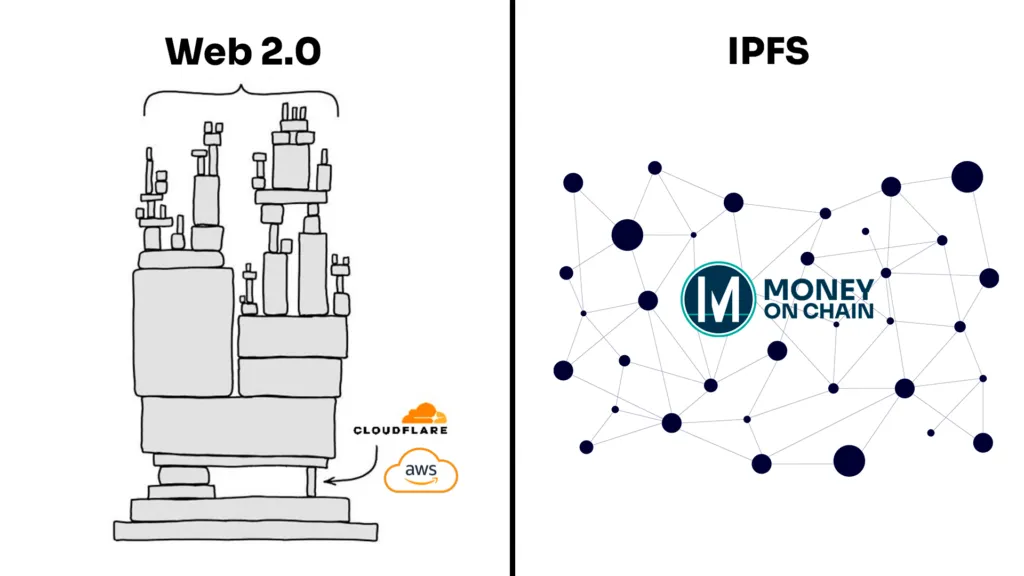
Money On Chain is so committed to decentralization that even the dapp’s frontend is hosted in a decentralized manner. Money On Chain doesn’t use the cloud, instead, it uses IPFS to host the dapp.
In this article, we’ll learn more about IPFS and decentralization, and why it’s important.
What is IPFS and how does it work?
IPFS (InterPlanetary File System) is a peer-to-peer protocol for storing and distributing files.
Its goal is to offer an alternative to the traditional internet model based on central servers (HTTPS) with a decentralized, censorship-resistant, and fault-tolerant one.
Instead of accessing a file by its URL (location), in IPFS, you access it by its content. This is called content addressing.
It’s like requesting a book by its exact content instead of by the library where it’s located.
Traditional Model vs. IPFS
Traditional Model (HTTPS)
- You access the web through a specific domain and file: https://example.com/home.html
- The website files are hosted on a server
- If the server becomes unavailable, you cannot access it
- If the domain is restricted, you cannot access it
IPFS
- You access a file identified by a cryptographic hash (CID)
- This hash depends on the exact content of the file. If the content changes, the hash changes.
- The file can be replicated across multiple nodes.
- Any node that has the file can respond to the request and serve it.
So, when a file (for example, the frontend code of a dapp) is uploaded to IPFS:
- It is divided into chunks.
- Each chunk is cryptographically hashed.
- A CID (Content Identifier) is generated that represents the entire content.
- The file can be served by any node that has it stored.
Every time a user accesses that CID, IPFS searches for the content on the network and downloads it from the nearest or most efficient node.
IPFS does not add systemic risk to the protocol, but instead reduces risks at the interface layer.
Gateways and content persistence
To make access more user-friendly and avoid having to remember an internet address containing a hash, access is done through gateways. This allows access from any browser without installing additional software.
Content on IPFS does not guarantee eternal persistence on its own; therefore, it must be “pinned.” This doesn’t mean that the Money On Chain frontend can “disappear,” but rather that the team is responsible for keeping the content pinned and accessible through multiple gateways.
In the Money On Chain GitHub repository, under Releases, several gateways are available to use the dapp.
Why does Money On Chain use IPFS to host the dapp?
Money On Chain is a stablecoin protocol collateralized with Bitcoin, and one of its focuses is decentralization. It runs on a decentralized Bitcoin sidechain that uses smart contracts and decentralized governance based on MOC tokens. It makes sense and shows consistency that the dapp hosting used to access and operate the protocol is also decentralized, without relying on custodians or centralized entities.
By not relying on a single service provider, IPFS makes the dapp harder to censor and more resistant to regional blockages.
Another interesting factor to consider is that this model reduces the risk of a user unknowingly interacting with a malicious interface (such as phishing, cloned frontends, or DNS hijacking). This is one of the most common attack vectors in DeFi. Manipulating smart contracts is more complex than manipulating the frontend. With IPFS, the content is linked to a hash, and any modification changes the CID (Content Identifier). The user always interacts with cryptographically verifiable content.
Using IPFS to host the Money On Chain dapp is not an aesthetic choice or a technological fad. It’s a choice consistent with the protocol’s values and the long-term Bitcoin vision.
Decentralization doesn’t end with the smart contract. How you access it also matters.
Because in Money On Chain, as in Bitcoin, the idea is clear: fewer intermediaries, more sovereignty.
If you want to learn more about the protocol, this is your next recommended reading.