
On this page
You can restore a wallet with the correct seed phrase and still see a zero balance. In many cases, the issue is not the seed phrase itself. It is the derivation path the wallet uses to generate and locate your addresses.
A derivation path tells a hierarchical deterministic wallet, or HD wallet, which branch of its key tree to follow when deriving a specific key. This matters when restoring a wallet, switching wallet software, importing accounts into a hardware wallet, or troubleshooting missing balances.
What is a derivation path?
A derivation path is a structured sequence that identifies a specific branch or key within an HD wallet.
For example:
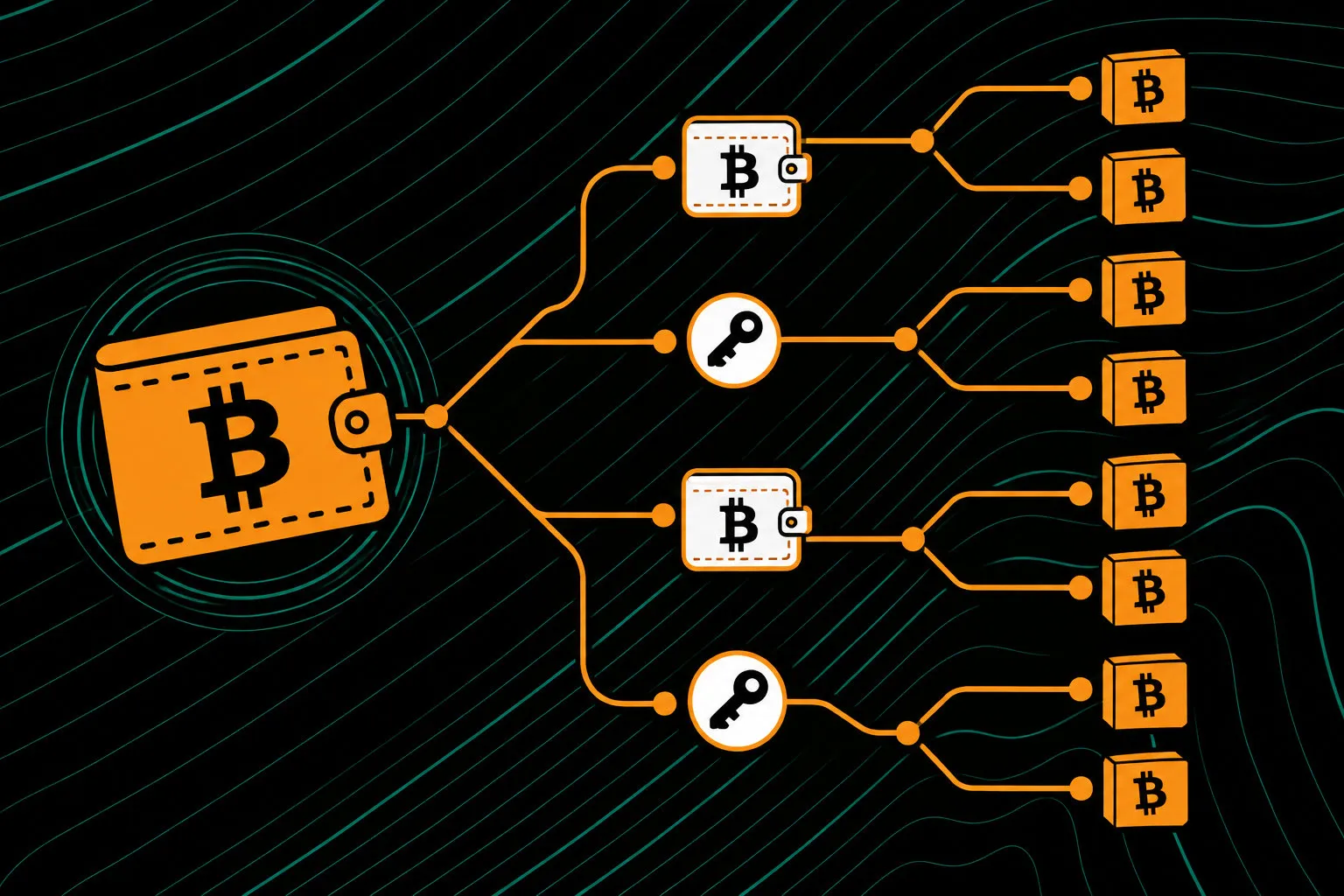
m/84'/0'/0'/0/0An HD wallet can generate a vast number of private keys and addresses from a single seed. Instead of storing every key independently, the wallet derives them deterministically from a common starting point.
The derivation path tells the wallet exactly where to look within that hierarchy.
The concept comes from BIP 32, which introduced hierarchical deterministic wallets. Later standards, including BIP 44, BIP 49, BIP 84, and BIP 86, defined conventions for organizing accounts and address types.
A useful analogy is a file system. The seed is the root, and each level of the derivation path is another folder leading to a specific key.
The process can be simplified as:
Seed phrase → seed → master key → derivation path → private key → address
Your seed phrase does not represent a single Bitcoin address. Instead, it can generate many different keys and addresses.
That is why two wallets using the same seed phrase can display different addresses if they follow different derivation paths.
The derivation path is not secret and does not replace the seed phrase. It is simply the set of instructions that tells the wallet which branch of the key hierarchy to derive.
How to read a derivation path
A common BIP 44-style structure looks like this:
m / purpose' / coin_type' / account' / change / address_indexEach section has a specific meaning.
The m represents the master node, which sits at the root of the HD wallet’s key tree.
Every derivation path begins here.
The purpose field usually identifies the standard being used.
For example, a path beginning with m/84’ generally follows BIP 84 and is used for Native SegWit Bitcoin addresses.
The next level identifies the cryptocurrency.
Bitcoin typically uses:
0'Other assets use different coin type values, allowing a single seed to derive separate key branches for multiple cryptocurrencies.
The account level allows users or wallet software to maintain multiple logically separate accounts under the same seed.
For example:
m/84'/0'/0'may represent the first account.
While:
m/84'/0'/1'represents a second account derived from the same seed.
This level usually takes one of two values:
- 0 for external addresses, typically used to receive funds.
- 1 for internal addresses, typically used for transaction change. This distinction is especially important in Bitcoin because UTXO-based transactions often send leftover funds to a change address controlled by the same wallet.
The final value identifies a specific address within that branch.
For example:
m/84'/0'/0'/0/0usually refers to the first receiving address.
Meanwhile:
m/84'/0'/0'/0/1refers to the next one.
As new addresses are generated, the wallet increments the address index.
What does the apostrophe mean?
The apostrophe in a derivation path indicates hardened derivation.
For example:
44'is a hardened child index.
Hardened derivation changes how child keys are derived and prevents certain relationships from being calculated using only an extended public key.
By contrast, non-hardened derivation allows child public keys to be derived from an extended public key. This is what makes use cases such as watch-only wallets possible.
In common BIP 44-style paths, the purpose, coin type, and account levels are hardened, while the change and address index levels are usually not.
Common Bitcoin derivation paths
Bitcoin wallets commonly use the following derivation paths.
m/44'/0'/0'/0/0This format is associated with traditional P2PKH addresses, which typically begin with 1.
m/49'/0'/0'/0/0This format is commonly associated with wrapped SegWit addresses, which usually begin with 3.
m/84'/0'/0'/0/0This path is used for Native SegWit addresses, which typically begin with bc1q.
m/86'/0'/0'/0/0This path is associated with Taproot addresses, which typically begin with bc1p.
Why the correct seed phrase can show a zero balance
One of the most common derivation path problems appears during wallet recovery.
You enter the correct seed phrase, the wallet restores successfully, but the expected transaction history and balance are missing.
That does not necessarily mean your funds are gone.
The new wallet may simply be scanning a different derivation path.
For example, suppose your Bitcoin was originally received using:
m/84'/0'/0'but the wallet you are restoring with searches:
m/44'/0'/0'Both paths can be derived from the same seed phrase, but they generate different keys and addresses.
If the wallet supports the correct address type or allows you to specify the original derivation path, your previous addresses and balance may reappear.
Account paths and complete address paths
It is also important to distinguish between an account-level path and a complete address path.
For example:
m/84'/0'/0'identifies an account-level branch.
By contrast:
m/84'/0'/0'/0/0points to a specific address within that account.
Some wallet interfaces display only the account path because they derive the change chain and address index automatically. Other tools expect the full derivation path.
This difference can create confusion when comparing paths across different wallets or recovery tools.
What is a gap limit?
Wallet software cannot scan an unlimited number of unused addresses during recovery.
To solve this, many wallets use a gap limit: the number of consecutive unused addresses they will check before assuming there are no more used addresses further down that branch.
A commonly referenced gap limit under BIP 44 is 20.
If a wallet generated many unused addresses before a later address received funds, a recovery scan may stop before reaching that funded address.
The keys are still derivable from the seed. The wallet simply has not scanned far enough.
This is one reason advanced wallet recovery sometimes requires adjusting the gap limit or address range.
Keeping recovery information safe
Your seed phrase is the most important recovery credential for an HD wallet, but documenting your derivation path can also be useful, especially if your wallet uses a non-standard configuration.
If you rely on a custom account structure, multisig setup, unusual wallet software, or a non-default address type, keeping a record of the derivation path can make future recovery significantly easier.
One security rule should never be ignored: never enter a real seed phrase into an online derivation tool or website simply to test different paths. Anyone who obtains your seed phrase may be able to derive your private keys and access your funds.
Use dummy seeds for testing, or work with reputable software in a secure offline environment.
A derivation path may look like nothing more than a string such as m/84’/0’/0’/0/0, but it plays a critical role in how an HD wallet organizes, derives, and recovers the keys behind your crypto addresses.